
Aluminium Door Section Manufacturer in USA
Introduction
Kesari Aluminium Company is a trusted manufacturer, supplier, exporter, and wholesaler of high-quality aluminium extrusion profiles, offering complete extrusion solutions for a wide range of industrial, commercial, and architectural applications. Backed by advanced manufacturing technology, skilled professionals, and a strong commitment to quality, we deliver precision-engineered aluminium profiles that meet the highest industry standards.
Aluminium is one of the most useful metals in modern industries because it is lightweight, strong, corrosion-resistant, and easy to shape. Aluminium extrusion is an important manufacturing process used to create different shapes and profiles for construction, engineering, transportation, electrical, automotive, and many other industries. Businesses looking for reliable aluminium profiles often search for an experienced Aluminium Extrusion Manufacturer in the USA that can provide quality products according to their requirements.
Kesari Aluminium Company is a trusted name in the aluminium industry, offering quality aluminium extrusion solutions for various industrial and commercial applications. With a focus on product quality, accurate dimensions, and customer requirements, the company works to provide dependable aluminium products for different projects. Along with international supply capabilities, Kesari Aluminium Company is a trusted name in the aluminium industry, offering quality aluminium extrusion products for customers looking for reliable and application-focused solutions.
What Is Aluminium Extrusion
Aluminium extrusion is a manufacturing process in which an aluminium billet is heated and pushed through a specially designed die. The die gives the aluminium its required shape and profile. Depending on the die design, manufacturers can produce simple as well as complex profiles. Aluminium extrusion is a manufacturing process in which an aluminium billet is heated and pushed through a specially designed die. The die gives the aluminium its required shape and profile. After extrusion, the profile is cooled, stretched, cut, and finished according to the required specifications.
Aluminium extrusion can be used to manufacture channels, angles, rods, tubes, frames, sections, and customised profiles. The process provides excellent flexibility, making it suitable for both standard and specialised applications. The extrusion process can create simple as well as complex shapes. Depending on the application, manufacturers can produce channels, angles, tubes, rods, frames, structural sections, and customised profiles.
Why Aluminium Extrusion Is Important
Aluminium has several properties that make it suitable for extrusion. It offers a good combination of strength and low weight. It also provides natural resistance against corrosion and can be finished in different ways to improve appearance and performance.
Extruded aluminium profiles are widely used because they can be designed according to the needs of a particular application. This helps manufacturers and engineers develop products that are both functional and cost-effective. For companies searching for an Aluminium Extrusion Manufacturer in USA, choosing a supplier with good manufacturing knowledge and quality control is important for obtaining consistent products.
Why Choose Kesari Aluminium Company
1. High-Quality Aluminium Extrusion Products
- Quality is one of the most important reasons to work with an experienced Aluminium Extrusion Manufacturer in USA. Professional manufacturers follow controlled production procedures to maintain consistency in dimensions, surface finish, strength, and overall performance. Aluminium extrusion can be manufactured using different alloys and profile designs depending on the application. A reliable manufacturer can help customers select a suitable material and profile according to strength, weight, corrosion resistance, finishing, and fabrication requirements. For industries where dimensional accuracy and repeatability are important, working with an experienced extrusion manufacturer can help maintain consistent product quality from prototype to large-volume production. Some U.S. manufacturers also combine extrusion with certified materials, automated presses, engineering support, and quality-management systems.
2. Custom Aluminium Profiles
- Every industrial application requires a standard aluminium profile. Many projects require a specially designed section that fits a particular assembly or product. A professional Aluminium Extrusion Manufacturer in USA can manufacture custom profiles based on customer drawings, CAD files, dimensions, samples, or technical specifications. Custom extrusion can help create profiles with channels, slots, ribs, hollow sections, mounting points, and other design features. The extrusion process provides considerable design flexibility because complex cross-sectional shapes can often be produced as a single profile instead of assembling multiple individual metal components.
3. Advanced Manufacturing Capabilities
- Modern aluminium extrusion requires more than simply producing a metal profile. Many industrial customers need additional services such as cutting, machining, drilling, punching, finishing, assembly, and packaging. Several U.S. extrusion manufacturers provide integrated services that can simplify the purchasing process. For example, extrusion, CNC machining, finishing, and assembly can be managed through one supplier instead of coordinating with several different vendors.
4. Better Design and Engineering Support
- Choosing an Aluminium Extrusion Manufacturer in USA can also provide access to experienced engineering teams. Before production starts, engineers can review the profile design and identify potential manufacturing challenges. They may recommend changes to wall thickness, tolerances, profile geometry, alloy selection, or finishing requirements. This design-for-manufacturing approach can help improve manufacturability while controlling material and production costs.
5. Consistent Dimensional Accuracy
- Dimensional consistency is essential when aluminium extrusion profiles are used as components in larger assemblies. Small dimensional variations can create fitting, alignment, or assembly problems. Experienced manufacturers use controlled extrusion processes and quality inspections to maintain the required dimensions and profile geometry. Some U.S. suppliers specifically offer precision extrusion and tight tolerances for specialised applications. Consistent profiles can make downstream machining and assembly easier and help manufacturers maintain repeatable product performance.
6. Reduced Machining and Material Waste
- One major advantage of aluminium extrusion is that the profile can be produced close to its required final shape. This can reduce the amount of machining needed after extrusion. When a suitable profile is designed correctly, manufacturers may be able to reduce cutting, drilling, milling, welding, and other secondary operations. This can improve material utilisation and reduce production time. The Aluminium Extrusion Council notes that extrusion can create complex shapes in one piece and simplify subsequent fabrication and assembly.
7. Reliable Domestic Supply Chain
- Supply-chain reliability is another important reason companies consider a USA-based aluminium extrusion manufacturer. Working with a domestic supplier can make communication, production planning, quality discussions, and logistics easier for U.S. customers. A closer manufacturing relationship can also make it easier to coordinate prototypes, production schedules, repeat orders, and engineering changes. For companies that depend on regular supplies of aluminium profiles, a reliable domestic manufacturing partner can help improve production planning and reduce uncertainty associated with long-distance sourcing.
9. Lightweight Yet Strong Material
- Aluminium offers an excellent strength-to-weight ratio. It is approximately one-third the weight of iron, steel, copper, or brass, making it attractive for applications where weight reduction is important. A good Aluminium Extrusion Manufacturer in USA can use profile geometry to place material where structural strength is needed while avoiding unnecessary material in other areas. This can help manufacturers design lighter components without automatically sacrificing functional performance.
10. Excellent Corrosion Resistance
- Aluminium naturally forms a thin oxide layer on its surface that helps protect it from corrosion. Additional surface treatments, such as anodizing and powder coating, can provide enhanced protection and achieve specific appearance requirements. This makes aluminium extrusion suitable for indoor and outdoor applications where long-term durability is important. Depending on the application, customers can select suitable finishing options to improve appearance, surface protection, wear resistance, or other performance requirements.
11. Different Finishing Options
- A professional extrusion supplier can provide more than a mill-finished profile. Depending on the manufacturer’s capabilities, customers may choose from finishing options such as anodising, powder coating, or other treatments. Surface finishing can improve the appearance of an aluminium profile while providing additional protection. It can also help manufacturers achieve a consistent look across multiple components. For architectural, commercial, lighting, automotive, and consumer applications, finishing is often an important part of the final product.
12. Cost-Effective for Large Production
- Aluminium extrusion can be a cost-effective manufacturing method, especially when the profile design reduces the need for multiple fabricated components and secondary machining operations. The tooling required for extrusion can also be relatively economical compared with some alternative manufacturing methods, while the same die can be used to produce large quantities of identical profiles.
14. Environmentally Responsible Material
- Aluminium is highly recyclable and can be recycled repeatedly without losing its fundamental properties. The Aluminium Extrusion Council identifies recyclability and the lightweight nature of aluminium as important sustainability advantages. Companies looking to improve the sustainability of their products can therefore consider aluminium extrusion as part of their material strategy.
Applications of Aluminium Extrusion
1. Building and Construction
- Building and construction is one of the major application areas for aluminium extrusions in the USA. Aluminium profiles are commonly used for window frames, door frames, curtain walls, railings, structural framing, cladding systems, partitions, and other architectural components. The lightweight nature of aluminium makes installation easier, while its corrosion resistance helps the profiles perform well in indoor and outdoor environments. Custom extrusion designs also allow architects and engineers to develop attractive and functional structures. An experienced Aluminium Extrusion Manufacturer in USA can manufacture profiles in different shapes, sizes, wall thicknesses, and finishes for residential, commercial, and industrial construction projects.
2. Automotive and Transportation
- The automotive industry is another important application for aluminium extrusions. Vehicle manufacturers use aluminium because reducing vehicle weight can support efficiency and performance goals. Aluminium extrusion is used in chassis components, roof rails, structural sections, heat-transfer components, panels, and other vehicle parts. The growing adoption of electric vehicles has further increased interest in lightweight aluminium components. Extruded aluminium can be used in battery-related structures, cooling systems, charging infrastructure, and vehicle frames.
3. Aerospace and Defense
- Aerospace applications require materials that provide strength while keeping weight under control. Aluminium extrusions are therefore used in various aircraft and aerospace components where suitable alloy and design specifications are required. Applications can include structural profiles, aircraft interiors, frames, supports, channels, and other engineered components. The aerospace and defence sectors are recognised application areas for aluminium extrusions.
4. Electrical and Electronics
- Aluminium extrusion is widely used in electrical and electronic equipment because aluminium provides good electrical and thermal conductivity while remaining lightweight. Common applications include electrical enclosures, housings, heat sinks, cable-management profiles, mounting structures, frames, and equipment cabinets. Custom aluminium profiles can be designed to accommodate components while providing ventilation and heat dissipation. This makes aluminium extrusion particularly useful for electronic equipment, power systems, control panels, and other electrical applications.
5. Energy and Solar Systems
- The energy sector is another important application for aluminium extrusion. Aluminium profiles are used in solar panel mounting structures, frames, supports, and related equipment. Because aluminium is lightweight and resistant to corrosion, it can be suitable for outdoor renewable-energy installations. Extruded profiles can also be designed for easy assembly and efficient installation. The increasing focus on energy-efficient infrastructure is supporting the use of aluminium extrusion in energy-related applications. The U.S. market includes electrical and energy as a major application segment.
6. Industrial Machinery and Equipment
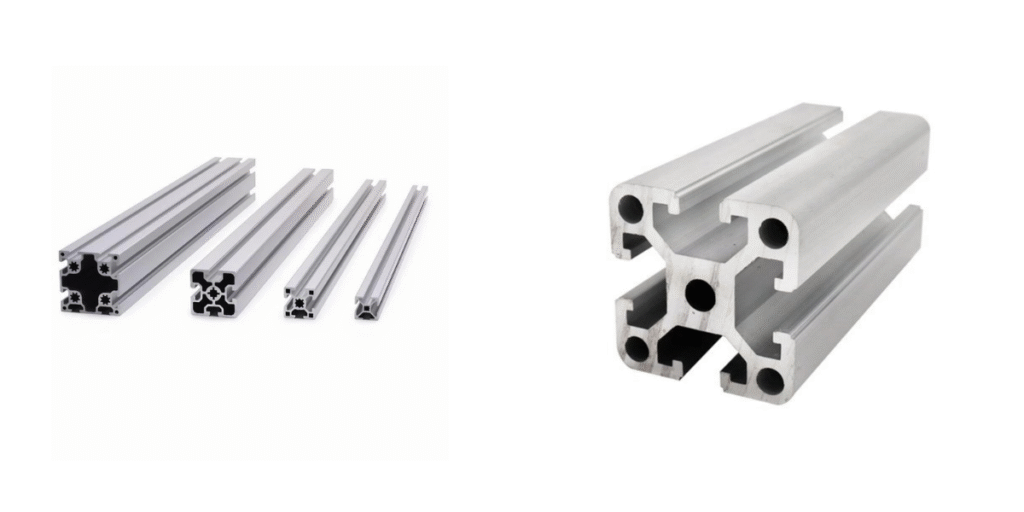
- Aluminium extrusion is extensively used for industrial machinery, automation systems, workstations, machine frames, safety guards, equipment supports, and production-line structures. T-slot and other modular aluminium profiles are especially useful where machines need flexible assembly and easy modification. Components can be connected using brackets, fasteners, and accessories without requiring complex fabrication. Manufacturers can produce customised profiles according to machine dimensions, load requirements, and assembly specifications.
7. HVAC and Heat Transfer
- Aluminium has excellent thermal conductivity, making it useful in HVAC and heat-transfer applications. Extruded aluminium profiles can be used for heat sinks, heat exchangers, air-conditioning components, ventilation equipment, and related systems. Aluminium extrusion allows manufacturers to create profiles with fins, channels, and other shapes that help increase surface area and improve heat transfer. The pipes and tubes segment also finds applications in HVAC systems, tunnels, airports, bridges, and other infrastructure projects.
8. Consumer Products
- Aluminium extrusions are used in many consumer products because they combine an attractive appearance with durability and low weight. Applications can include furniture frames, shelving systems, lighting products, appliances, fitness equipment, display systems, and home improvement products. The ability to manufacture customised profiles allows product designers to achieve specific shapes and dimensions. Aluminium can also be finished through anodising or powder coating to provide different appearances and additional surface protection.
9. Infrastructure Projects
- Aluminium extrusions are used in infrastructure applications such as bridges, rail systems, transportation facilities, public structures, and other engineered projects. Their lightweight construction can simplify transportation and installation, while their corrosion resistance can be beneficial in demanding environments. Extruded aluminium profiles can be manufactured in structural shapes such as channels, angles, beams, tubes, and custom sections.
10. Medical and Healthcare Equipment
- The healthcare industry also uses aluminium extrusions for equipment frames, medical carts, support structures, furniture, equipment housings, and other components. Aluminium’s lightweight properties make equipment easier to move, while its ability to be fabricated into precise shapes supports different product designs. Clean and attractive surface finishes can also be selected according to the intended application.
Specification Table of Aluminium Extrusion
| Parameter | Specification |
|---|---|
| Material | Aluminium Extrusion |
| Product | Aluminium Alloy |
| Common Grades | 6061, 6063, 6005, 6082 |
| Temper | T4, T5, T6, O, As Required |
| Shape | Round, Square, Rectangular, T-Profile, U-Profile, Custom |
| Surface Finish | Mill Finish, Anodized, Powder Coated, Polished |
| Extrusion Length | As Per Customer Requirement |
| Wall Thickness | As Per Profile Design |
| Dimensional Tolerance | As Per Applicable Standards |
| Color Options | Silver, Black, Bronze, Custom |
| Customization | Available |
| Application | Construction, Automotive, Electrical, Industrial, Furniture, Solar & Engineering |
| Packaging | Standard / Customized Packaging |
Benefits of Aluminium Extrusion
1. Lightweight Yet Strong Profiles
- One of the biggest benefits of aluminium extrusion is its excellent strength-to-weight ratio. Aluminium is significantly lighter than materials such as steel, while still providing the strength required for many structural and industrial applications. This makes extruded aluminium useful where reducing overall product weight is important. Lightweight profiles are particularly valuable in transportation, machinery, automation, aerospace, and mobile equipment. Lower weight can make components easier to handle, transport, and install while helping manufacturers develop efficient product designs.
2. Excellent Design Flexibility
- An experienced Aluminium Extrusion Manufacturer in the USA can produce profiles in a wide range of shapes and sizes. The extrusion process can create channels, tubes, angles, beams, frames, heat-sink profiles, structural sections, and many other customised cross-sections. This design flexibility allows engineers to place material exactly where it is required. Internal ribs, varying wall thicknesses, grooves, slots, and other features can often be incorporated directly into the extrusion profile.
3. Customised Aluminium Extrusion Solutions
- Every industrial project can have different dimensional, structural, and performance requirements. A professional manufacturer can work with customers to develop custom aluminium extrusion profiles based on drawings, samples, CAD files, or engineering specifications. Custom extrusion can help reduce the need for multiple assembled components. A single extruded profile can sometimes replace several fabricated parts, reducing joints, fasteners, and assembly requirements.
4. Corrosion Resistance
- Aluminium naturally develops a thin oxide layer that protects its surface from corrosion. This makes aluminium extrusion a suitable choice for many indoor and outdoor applications. For applications requiring additional surface protection or a particular appearance, aluminium profiles can also be treated using processes such as anodising and other finishing methods. This corrosion resistance is especially useful for construction products, transportation components, solar structures, outdoor equipment, and industrial systems.
5. Cost-Effective Manufacturing
- Aluminium extrusion can be a cost-effective manufacturing solution, particularly when producing large quantities of consistent profiles. Extrusion tooling is generally less expensive and faster to produce than tooling used in some alternative manufacturing processes. Once the die is prepared, manufacturers can produce long lengths of consistent aluminium profiles that can subsequently be cut, machined, drilled, punched, bent, or assembled according to project requirements.
6. Faster Product Development
- Speed is important for businesses developing new products or bringing existing products to market. Aluminium extrusion can support faster development because extrusion dies can generally be produced relatively quickly compared with some other tooling methods. The process is suitable for both prototypes and production applications, allowing manufacturers to test profile designs before moving toward larger production volumes.
7. Excellent Thermal Conductivity
- Aluminium is an excellent conductor of heat, which makes extruded aluminium particularly useful for thermal-management applications. Specially designed aluminium extrusion profiles can incorporate cooling fins and other features that increase surface area for heat dissipation. These profiles are commonly used in heat sinks, electronic equipment, LED lighting, industrial machinery, HVAC systems, and other applications where controlling temperature is important.
8. Easy Fabrication and Assembly
- Another important advantage is the ability to perform secondary operations on extruded aluminium profiles. Depending on the application, profiles can be cut, drilled, punched, machined, bent, welded, or otherwise fabricated. A manufacturer that offers extrusion along with fabrication services can provide more complete components instead of supplying only raw extrusion lengths.
9. Consistent Quality and Dimensional Accuracy
- Industrial applications often require profiles with consistent dimensions and repeatable performance. The controlled extrusion process allows manufacturers to produce long lengths of aluminium with uniform cross-sections. Reliable dimensional control is particularly important when profiles must fit into assemblies, machinery, frames, heat exchangers, transportation systems, or automated equipment.
Types of Aluminium Extrusion
1. Direct Aluminium Extrusion
- Direct extrusion is one of the most commonly used extrusion methods. In this process, the aluminium billet is placed inside a container and pushed directly through a die by a ram. The aluminium takes the shape of the die opening. This method is suitable for producing a wide range of standard and customised aluminium profiles.
2. Indirect Aluminium Extrusion
- In indirect extrusion, the die moves toward the aluminium billet instead of pushing the billet directly through a stationary die. This process can reduce friction and may provide better control over certain extrusion requirements. It is used for specific applications where manufacturing conditions require indirect extrusion technology.
3. Hot Aluminium Extrusion
- Hot extrusion involves heating aluminium before it is pushed through the die. Heating makes the material softer and easier to form. Hot extrusion is commonly used for producing complex profiles and larger aluminium sections where high forming pressure would otherwise be required.
4. Cold Aluminium Extrusion
- Cold extrusion is performed at or near room temperature. It can provide good dimensional accuracy and surface finish. Cold extrusion is suitable for applications requiring precise shapes and tighter dimensional control.
5. Seamless Aluminium Extrusion
- Seamless extrusion is used to produce profiles and tubular products without conventional welded seams. These products can be useful in applications where structural integrity and appearance are important.
6. Hollow Aluminium Profiles
- Hollow profiles contain internal spaces and are designed to reduce weight while maintaining useful structural properties. They are widely used in frames, transportation systems, furniture, machinery, and construction applications.
Conclusion
Aluminium extrusion is an efficient and flexible manufacturing process that helps industries create lightweight, durable, and accurately shaped aluminium profiles. From construction and automotive applications to solar systems, machinery, furniture, and electrical equipment, aluminium extrusion has a wide range of uses. The right Aluminium Extrusion Manufacturer in USA can help businesses select suitable profiles, develop customised designs, maintain dimensional accuracy, and meet production requirements.
Kesari Aluminium Company is committed to delivering reliable aluminium extrusion solutions with a focus on quality, precision, customisation, and customer satisfaction. Whether you need standard aluminium sections or customised extrusion profiles, Kesari Aluminium Company can be a valuable manufacturing partner for your aluminium requirements.