
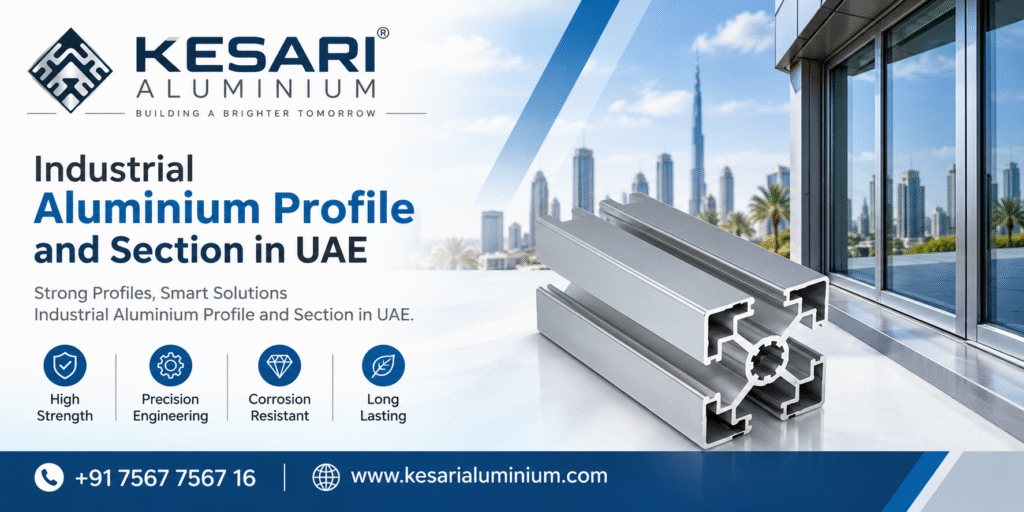
Industrial Aluminium Profile and Section in UAE
Introduction
Kesari Aluminium Company is a trusted manufacturer, supplier, exporter, and wholesaler of high-quality aluminium extrusion profiles, offering complete extrusion solutions for a wide range of industrial, commercial, and architectural applications. Backed by advanced manufacturing technology, skilled professionals, and a strong commitment to quality, we deliver precision-engineered aluminium profiles that meet the highest industry standards.
Aluminium is one of the most useful metals used in modern industries. It is lightweight, strong, corrosion-resistant, and easy to work with. Because of these qualities, aluminium profiles and sections are widely used in construction, engineering, manufacturing, transportation, automation, and many other industries. Businesses looking for dependable industrial aluminium profiles and sections in UAE need products that offer consistent quality, accurate dimensions, and long service life.
Industries across the UAE need materials that are strong, lightweight, durable, and easy to use. Aluminium is one of the most useful metals for industrial applications because it offers a good balance of strength, low weight, corrosion resistance, and flexibility. Among the many aluminium products available today, industrial aluminium profiles and sections in UAE are widely used in manufacturing, construction, engineering, automation, fabrication, and many other industries.
Kesari Aluminium Company is focused on providing quality aluminium solutions for industrial and commercial requirements. With attention to product quality, dimensional accuracy, and customer requirements, the company can support businesses looking for dependable aluminium profiles and sections. We are the best Industrial Aluminium Profile and Section Manufacturer.
What Are Industrial Aluminium Profiles and Sections
- Industrial aluminium profiles and sections are aluminium products manufactured in specific shapes and dimensions for engineering, structural, and fabrication applications. They are commonly produced through an extrusion process. During extrusion, aluminium is pushed through a specially designed die to create the required cross-sectional shape. We are the best Industrial Aluminium Profile and Section Supplier.
- Aluminium channels
- Aluminium angles
- Aluminium T-sections
- Aluminium U-sections
- Aluminium square sections
- Aluminium rectangular sections
- Aluminium hollow profiles
- Custom aluminium extrusion profiles
- Structural aluminium profiles
- The correct profile depends on the application, load requirements, design, and operating environment. Profiles can be manufactured in simple or complex designs depending on the application. Common shapes include angles, channels, T-sections, U-sections, square sections, rectangular sections, and customised profiles.
Types of Industrial Aluminium Profiles and Sections
1. T-Slot Aluminium Profiles
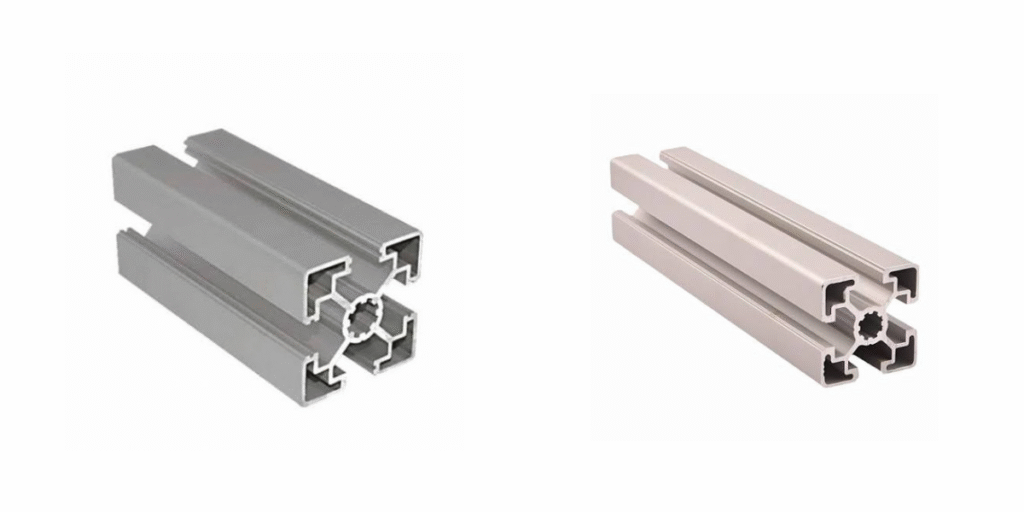
- T-slot aluminium profiles are among the most commonly used industrial profiles. They have specially designed slots that allow components, brackets, panels, and accessories to be fixed easily. These profiles are popular for machine frames, workstations, production lines, safety guards, and assembly tables. Their modular design makes them easy to assemble and modify without extensive welding. This is useful for UAE industries where production layouts may need to change according to operational requirements.
2. Aluminium U Sections
- U-shaped aluminium sections are designed with two parallel sides connected by a base. They are commonly used for framing, edge protection, support structures, channels, and fabrication work. U sections are available in different widths and thicknesses, allowing manufacturers to select a suitable size according to the load and application. Their clean appearance also makes them useful in applications where both performance and appearance are important.
3. Aluminium L Sections or Angles
- L-shaped aluminium sections are widely used for structural support, corners, frames, brackets, and fabrication applications. They provide a simple way to reinforce joints and edges. Aluminium angles are lightweight while offering good structural support. They can also be cut and drilled according to project requirements, making them suitable for customised industrial fabrication.
4. Aluminium Square Profiles
- Square aluminium profiles provide a balanced structure and are frequently used for machine frames, equipment stands, cabinets, enclosures, display structures, and industrial workstations. They are available in various dimensions and wall thicknesses. Their symmetrical shape helps create stable structures while maintaining a relatively low overall weight.
5. Aluminium Rectangular Sections
- Rectangular aluminium sections are useful when a wider or differently proportioned structural profile is required. They are used in frames, supports, partitions, equipment structures, and fabrication projects. These sections can be supplied in different dimensions and thicknesses depending on the requirements of the customer. Their versatility makes them suitable for both light-duty and selected structural applications.
6. Aluminium Round Tubes and Sections
- Round aluminium sections are used where a smooth, curved profile is preferred. They are commonly found in machinery, handrails, frames, tubular structures, transportation-related components, and fabrication work. The circular design can provide good strength-to-weight characteristics while also giving the finished product a neat appearance.
Applications of Industrial Aluminium Profile and Section
1. Industrial Machine Frames
- One of the major applications of Industrial Aluminium Profile and Section in UAE is the manufacturing of machine frames. Aluminium profiles can be assembled into strong and stable structures for automated machines, production equipment, inspection systems, and industrial workstations. Their modular design allows manufacturers to modify or expand machine frames when production requirements change.
2. Factory Workstations
- Industrial workstations require strong structures that can withstand regular industrial use. Aluminium profiles are commonly used to build workbenches, assembly stations, packing tables, tool stations, and operator work areas. Accessories such as brackets, connectors, panels, shelves, and wheels can be added to create customised workstation solutions.
3. Conveyor System Structures
- Aluminium sections are useful for supporting conveyor systems in manufacturing and logistics facilities. They can be used to manufacture conveyor frames, support stands, side structures, and guarding systems. Since aluminium is relatively lightweight, installation and movement of these structures can be easier compared with heavier metal frameworks.
4. Automation and Robotics
- The UAE is seeing increasing use of industrial automation in manufacturing, packaging, warehousing, and logistics. Industrial aluminium profiles are suitable for robot cells, automation frames, safety enclosures, sensor mounting structures, and machine guarding. Their modular construction makes it possible to reposition components and integrate new equipment as automation systems develop.
5. Machine Guarding and Safety Enclosures
- Industrial machines often need protective guarding around moving components. Aluminium profiles can be assembled with polycarbonate, acrylic, wire mesh, or other suitable panels to create machine guards and safety enclosures. These structures can provide visibility while helping separate operators from moving machinery.
6. Cleanroom and Controlled Environments
- Aluminium profiles can also be used in selected cleanroom and controlled-environment applications. They may be used for partitions, equipment frames, support structures, inspection stations, and customised enclosures. The smooth and practical construction of aluminium framing can support applications where easy maintenance and organised equipment layouts are important.
7. Solar Panel Mounting Structures
- The UAE’s strong focus on solar energy creates demand for lightweight and corrosion-resistant structural materials. Aluminium profiles can be used in certain solar mounting applications, including support frames, panel structures, brackets, and related assemblies. Their corrosion resistance can be particularly useful in outdoor environments when the correct aluminium alloy and surface finish are selected for the application.
8. Architectural and Commercial Structures
- Industrial aluminium sections are not limited to factories. They can also be incorporated into commercial and architectural projects. They may be used for partitions, display structures, interior frameworks, doors, windows, façade components, and decorative structures, depending on the profile design and required specifications.
9. Warehouse and Storage Systems
- Warehouses in the UAE require practical storage and material-handling solutions. Aluminium profiles can be used for lightweight storage frames, shelving structures, trolley systems, picking stations, packing tables, and support assemblies. Their modular nature allows businesses to create storage arrangements according to available floor space.
10. Material Handling Equipment
- Industrial aluminium profiles are suitable for manufacturing carts, trolleys, racks, material-handling frames, and mobile workstations. These applications benefit from aluminium’s combination of strength and relatively low weight. Wheels, handles, shelves, and other components can be integrated into the profile-based structure.
11. Display and Exhibition Systems
- Retail businesses, exhibitions, trade shows, and commercial events require temporary and reusable structures. Aluminium sections can be used for display stands, product frames, exhibition booths, signage supports, and promotional structures. Their lightweight nature makes transportation and assembly more convenient.
Q1. What is an Industrial Aluminium Profile and Section in UAE?
Industrial aluminium profiles and sections are specially shaped aluminium extrusions used to build, support, protect, or connect different industrial and engineering components.
In simple words, aluminium is pushed through a specially designed die to create a continuous shape. This shape can be square, rectangular, round, T-shaped, channel-shaped, or completely customised according to the application.
In the UAE, aluminium profiles are useful in construction, engineering, manufacturing, electrical equipment, machinery, solar systems, commercial interiors, and many other applications. Aluminium extrusion is also widely associated with modern UAE construction because it can combine lightweight construction with useful strength and corrosion resistance.
For businesses looking for an Industrial Aluminium Profile and Section in UAE, selecting the right alloy, profile design, thickness, finish, and dimensions is important.
Q2. Why are aluminium profiles useful for industrial applications?
Aluminium has a useful combination of low weight, durability, corrosion resistance, and flexibility in manufacturing.
Industrial profiles can be designed around the actual job instead of forcing one standard section to perform every function. This makes aluminium extrusion suitable for machine frames, equipment components, structural supports, enclosures, heat-management products, and fabricated assemblies.
A UAE application can also demand attention to surface finish and long-term performance because profiles may be exposed to heat, humidity, dust, and coastal environments.
Industry guidance on UAE extrusion applications notes that 6000-series aluminium alloys are commonly considered for construction because of their strength-to-weight characteristics and corrosion resistance.
Q3. What types of Industrial Aluminium Profiles and Sections are available?
There is no single aluminium section for every requirement. Common types include:
1. Square and Rectangular Profiles
These are useful for frames, supports, structures, machinery, and fabrication work.
2. T-Slot Aluminium Profiles
T-slot designs are useful where components need to be assembled, adjusted, or connected without extensive welding.
3. Channel Sections
Channel-shaped aluminium sections can be used for supports, frames, covers, tracks, and engineering structures.
4. Aluminium Heat Sink Profiles
These profiles are designed to help manage and transfer heat in electrical and electronic applications. Kesari Aluminium includes heat sink profiles in its extrusion portfolio.
5. Industrial Custom Profiles
A custom extrusion can be developed when an ordinary section does not match the required dimensions or geometry.
6. Architectural and Engineering Sections
These include railing, door, window, curtain-wall, elevator, and other application-specific profiles.
Q4. Where are Industrial Aluminium Profiles used in the UAE?
Industrial aluminium profiles can be found in many sectors.
Some important applications include:
- Industrial machinery
- Factory equipment
- Machine frames
- Electrical and electronic products
- Heat sinks
- Solar and renewable-energy equipment
- Automotive components
- Commercial interiors
- Furniture systems
- Construction and infrastructure
- Curtain-wall systems
- Doors and windows
- Railings and handrails
- Elevator systems
- Textile machinery
Kesari Aluminium’s current product portfolio covers industrial, architectural, electrical, engineering, machinery, solar, furniture, railway, and general engineering applications.
This wide application range is one reason aluminium extrusion continues to be an important manufacturing material.
Q5. What makes aluminium suitable for the UAE environment?
The UAE has a hot climate, and many applications also face dust, moisture, and coastal conditions.
Aluminium is naturally useful in such environments because it forms a protective oxide layer that helps resist corrosion. The exact performance, however, depends on the alloy, profile design, finish, application, and environmental exposure.
For some projects, surface finishing can provide additional protection and the desired appearance.
Kesari Aluminium offers profiles with mill, anodised, and powder-coated finishes, depending on the application and requirement.
So, rather than simply asking for an aluminium profile, buyers should explain where the profile will be used.
Why Choose Kesari Aluminium Company
1. Lightweight and Easy to Handle
- One of the biggest advantages of aluminium profiles is their lightweight nature. Compared with many traditional metals, aluminium is easier to transport, handle, cut, drill, and install. This can make fabrication and assembly more convenient, especially for industrial structures, machine frames, partitions, supports, and enclosures.
2. Good Strength for Industrial Applications
- Although aluminium is lightweight, properly selected aluminium profiles can provide excellent structural performance. Different shapes and thicknesses can be used to achieve the required strength and rigidity. This makes aluminium profiles suitable for machine frames, workstations, conveyor structures, equipment supports, and other industrial applications.
3. Excellent Corrosion Resistance
- The UAE has a hot and often challenging environment, where dust, humidity, and coastal conditions can affect metal components. Aluminium naturally forms a thin protective oxide layer on its surface, helping it resist corrosion. This makes Industrial Aluminium Profile and Section in UAE a practical option for applications where long-term durability is important.
4. Suitable for Hot Climate Conditions
- Aluminium can be used in a wide range of industrial environments. Its combination of durability, low weight, and resistance to corrosion makes it useful for projects operating in demanding climatic conditions. With the right grade, design, and surface treatment, aluminium sections can support various indoor and outdoor applications.
5. Flexible Design Options
- Industrial aluminium profiles are available in many shapes, sizes, wall thicknesses, and cross-sectional designs. This gives engineers and fabricators flexibility when developing customised structures. Profiles can be selected according to the required dimensions and application instead of depending on a single standard design.
6. Easy to Fabricate
- Aluminium is relatively easy to machine and fabricate. It can be cut, drilled, milled, bent, joined, and assembled using suitable techniques and equipment. This helps manufacturers create customised components and structures while maintaining efficient production processes.
7. Attractive Surface Finish
- Aluminium profiles can provide a clean and professional appearance. Different surface finishes, including anodised and powder-coated options, can be selected depending on the project requirements. A suitable finish can improve appearance while also providing additional surface protection.
8. Useful for Automation and Machine Building
- Automation industries require accurate, modular, and easy-to-assemble structural components. Aluminium profiles are commonly used for machine frames, safety guards, conveyor systems, robotic workstations, inspection stations, and production-line structures. Their modular nature also makes modifications and extensions easier.
9. Low Maintenance Requirements
- A major reason businesses select aluminium is its relatively low maintenance requirement. Its corrosion-resistant surface and durable nature can reduce the need for frequent replacement or intensive maintenance when the correct material and finish are selected for the application.
10. Excellent Thermal and Electrical Properties
- Aluminium has good thermal conductivity, which makes it useful in applications where heat transfer is required. It also has useful electrical conductivity and is widely used in engineering applications. The exact suitability depends on the aluminium alloy, profile design, operating conditions, and application requirements.
11. Environmentally Friendly Material
- Aluminium is highly recyclable. Scrap aluminium and end-of-life aluminium products can be recycled and used again. This makes aluminium an attractive material for businesses looking to incorporate more sustainable material choices into their industrial and construction projects.
Choosing the Right Industrial Aluminium Profile
Before purchasing aluminium profiles, businesses should consider several factors. The required dimensions, thickness, aluminium grade, profile shape, application, load requirements, surface finish, and quantity should be clearly identified. For customised profiles, technical drawings or detailed measurements can help manufacturers understand the exact requirements.
The operating environment should also be considered. Outdoor applications, industrial facilities, coastal areas, and high-temperature environments may have different material and finishing requirements. Working with an experienced supplier can make the selection process easier and help reduce errors in dimensions or specifications.
Aluminium Profiles for Growing UAE Industries
The UAE continues to develop its construction, manufacturing, infrastructure, renewable energy, transportation, and commercial sectors. As these industries grow, the requirement for lightweight and durable materials is also increasing.
Industrial aluminium profiles and sections can support this development by providing flexible material solutions for different types of projects. Their combination of low weight, corrosion resistance, fabrication flexibility, and modern appearance makes them useful across many sectors.
From a small fabrication requirement to a large industrial project, selecting the appropriate aluminium profile is important for achieving the desired result. Businesses should carefully evaluate their technical requirements and work with a supplier that understands the importance of quality and consistency.
Conclusion
Industrial Aluminium Profile and Section in UAE are valuable products for modern construction, engineering, manufacturing, solar, transportation, and fabrication applications. Their lightweight nature, corrosion resistance, flexibility, and range of available shapes make them suitable for many industrial requirements. We are the best Industrial Aluminium Profile and Section Exporter.
For companies searching for reliable aluminium solutions, Kesari Aluminium Company can provide products suited to different project needs. By focusing on product quality, accurate dimensions, customisation, and customer requirements, Kesari Aluminium Company aims to become a dependable partner for businesses requiring aluminium profiles and sections.
“The right aluminium profile is not simply about choosing a lightweight material. Profile geometry, alloy, wall thickness, finish, and the intended application all have to work together. A properly designed extrusion can make fabrication, assembly, and long-term performance much more efficient.”
— Technical perspective from Kesari Aluminium Company