
Aluminium Textile Machine Profile in Europe
Introduction
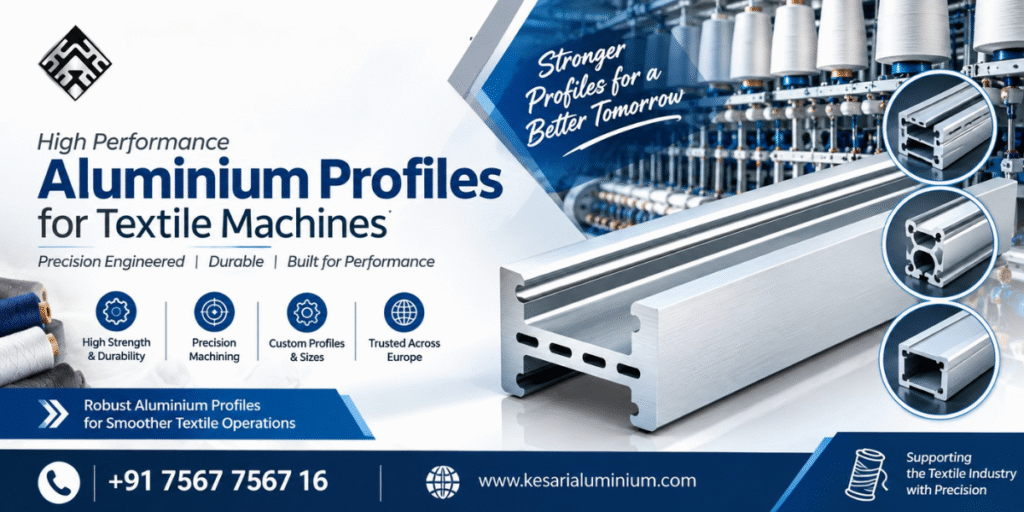
Kesari Aluminium Company is a trusted manufacturer, supplier, exporter, and wholesaler of high-quality aluminium extrusion profiles, offering complete extrusion solutions for a wide range of industrial, commercial, and architectural applications. Backed by advanced manufacturing technology, skilled professionals, and a strong commitment to quality, we deliver precision-engineered aluminium profiles that meet the highest industry standards.
The textile industry in Europe is known for advanced manufacturing, high production standards, and modern textile machinery. Textile machines used in spinning, weaving, knitting, dyeing, finishing, and other processes require strong and reliable components for smooth operation. Among these components, aluminium textile machine profiles are widely used because aluminium offers a good combination of strength, light weight, corrosion resistance, and easy fabrication. For textile machine manufacturers and industrial buyers, choosing the right Aluminium Textile Machine Profile in Europe can help improve machine performance, reduce unnecessary weight, and support long-term production. Aluminium profiles can be designed and manufactured for different machine structures, frames, covers, supports, guides, and other applications. We are the best Aluminium Textile Machine Profile Manufacturer.
An Aluminium Textile Machine Profile in Europe is designed to provide a strong, lightweight, and flexible structural solution for textile machine manufacturers, automation companies, and industrial equipment builders. Aluminium profiles can be used for machine frames, guards, supports, conveyors, workstations, enclosures, and other machine structures. Kesari Aluminium Company is an experienced aluminium profile manufacturer offering quality aluminium extrusion solutions for industrial applications. With a focus on precision, customisation, and consistent quality, the company serves customers looking for dependable aluminium profiles for textile machinery and other industrial requirements.
What Is an Aluminium Textile Machine Profile
An aluminium textile machine profile is an extruded aluminium section specially designed for use in textile machinery and related equipment. These profiles are manufactured by passing heated aluminium through a specially designed die to achieve the required shape and dimensions. Aluminium is particularly useful for textile machines because machinery often requires lightweight structural components without compromising stability. Depending on the design, profiles can be used for machine frames, covers, panels, supports, guards, mounting structures, and other components.
The profile can be produced in different sizes, shapes, wall thicknesses, and designs according to the application. Depending on the machine requirement, profiles can also include slots, grooves, holes, and other features that make assembly easier. For European textile machinery manufacturers, aluminium profiles provide an efficient alternative to heavier structural materials. In Europe, where industrial equipment is expected to meet high standards of performance and reliability, manufacturers look for aluminium profiles that provide accurate dimensions and consistent quality. We are the best Aluminium Textile Machine Profile Supplier.
Why Aluminium Profiles Are Used in Textile Machinery
Textile machinery requires structures that are strong but should not unnecessarily increase machine weight. Aluminium offers a useful combination of strength, low weight, corrosion resistance, and easy fabrication. Modern textile machines operate continuously and often require lightweight but strong structures. Aluminium provides an effective combination of strength, weight, corrosion resistance, and flexibility.
- Lightweight construction
- Good structural strength
- Easy machining and fabrication
- Corrosion resistance
- Customizable designs
- Good dimensional accuracy
- Suitable for automated machinery
An aluminium textile machine profile is an extruded aluminium section designed for use in textile machinery and related industrial equipment. These profiles can be manufactured in different shapes, sizes, thicknesses, and surface finishes according to application requirements. The main advantage of aluminium extrusion is that manufacturers can create profiles according to specific engineering requirements. This makes aluminium profiles suitable for both standard machinery and customised textile equipment.
Applications of Aluminium Textile Machine Profiles
1. Textile Spinning Machines
- Aluminium textile machine profiles are used in the construction of spinning machines and their supporting structures. They can form machine frames, protective enclosures, working platforms, and support assemblies. Their lightweight structure helps reduce the overall machine weight while maintaining sufficient mechanical strength. Aluminium profiles can also provide convenient mounting points for sensors, electrical components, guards, and operating systems.
2. Weaving Machines
- Weaving machinery requires rigid and accurately aligned structures because the equipment operates continuously at high speeds. Aluminium machine profiles can be used for supporting frames, safety guards, inspection structures, control panels, and auxiliary assemblies. The modular nature of aluminium profiles allows machine manufacturers to modify the structure when weaving equipment is upgraded or redesigned.
3. Knitting Machines
- Knitting machines contain several mechanical, electrical, and control components that require organised structural support. Aluminium profiles are suitable for building machine frames, operator stations, covers, component supports, and modular assemblies. The profiles can be cut to specific lengths and connected using brackets and fasteners, reducing the need for extensive welding during machine construction.
4. Textile Winding Machines
- Winding machines require stable and accurately constructed frames to maintain consistent production performance. Aluminium profiles can be used to create supporting structures around winding units, rollers, control systems, sensors, and protective covers. Their easy installation makes them particularly useful when textile machinery manufacturers need to produce different machine configurations for European customers.
5. Warping Machines
- Warping equipment requires strong supporting structures for rollers, beams, tension-control systems, and other components. Aluminium textile machine profiles can provide structural support while keeping the equipment comparatively lightweight. The profiles can also be integrated with protective panels and safety systems to create a clean and organised machine layout.
6. Textile Printing Machines
- Modern textile printing equipment incorporates mechanical systems, electronics, control units, printing heads, and material-handling components. Aluminium profiles are often suitable for creating frames and support structures for these systems. Their smooth appearance and modular construction are also beneficial for European machinery manufacturers that prioritise clean machine design and easy maintenance.
7. Textile Dyeing Equipment
- Aluminium profiles can be used for supporting control systems, operator panels, instrumentation, electrical cabinets, and auxiliary structures around textile dyeing machinery. Although components exposed directly to aggressive chemicals may require specialised materials, aluminium profiles can be selected for suitable structural applications where their corrosion resistance and lightweight characteristics provide an advantage.
8. Textile Inspection Machines
- Quality inspection is an important part of modern textile production. Inspection machines often require camera mounts, lighting supports, sensor brackets, display structures, and protective frames. Aluminium profiles provide an easy way to build adjustable structures for these components. Their T-slot systems allow cameras, sensors, lighting units, and other accessories to be repositioned when necessary.
9. Machine Safety Guards and Enclosures
- Worker safety is a major consideration in European industrial environments. Aluminium profiles can be used to build machine guarding and protective enclosures around moving textile machinery. They can be combined with polycarbonate sheets, acrylic panels, mesh, or other suitable materials to create protective barriers. Doors and access panels can also be integrated into the profile structure.
10. Textile Automation Systems
- European textile factories increasingly use automated production systems to improve productivity and reduce manual intervention. Aluminium machine profiles are well suited for automation structures such as robotic cells, pick-and-place systems, sensor frames, and automated handling equipment. The profiles make it easier to integrate pneumatic components, electrical systems, sensors, linear motion components, and robotic equipment.
11. Operator Workstations
- Textile machinery often requires dedicated operator stations for monitoring production, controlling machinery, and carrying out inspections. Aluminium profiles can be used to construct ergonomic workstations, control-panel stands, monitor mounts, shelves, and equipment supports. Because the profile structure is modular, workstation height and component positioning can be adjusted according to machine requirements.
Benefits of Aluminium Textile Machine Profiles
1. Lightweight Construction
- One of the major benefits of an aluminium textile machine profile is its lightweight nature. Aluminium is considerably lighter than many traditional structural metals while still providing good mechanical strength. This makes machine frames and supporting structures easier to handle, assemble, transport, and modify. For European textile machinery manufacturers, lightweight construction can also help reduce the overall weight of automated equipment without unnecessarily compromising structural performance.
2. High Strength-to-Weight Ratio
- Aluminium profiles offer an excellent balance between weight and strength. Properly designed profiles can provide the rigidity required for textile machine frames, equipment supports, guarding structures, and production-line assemblies. This strength-to-weight ratio makes aluminium a practical choice for manufacturers looking to develop efficient and compact textile machinery.
3. Excellent Corrosion Resistance
- Textile manufacturing environments can expose machine components to moisture, dust, cleaning chemicals, and other operating conditions. Aluminium naturally develops a protective oxide layer that helps resist corrosion. This makes aluminium textile machine profiles suitable for applications where long-term surface durability and low maintenance are important.
4. Easy Machine Assembly
- Aluminium profiles are available in different shapes, sizes, and slot configurations. They can be assembled using compatible brackets, T-nuts, connectors, fasteners, and other accessories. This allows European machine builders to create customised textile machine structures without extensive welding or complicated fabrication processes.
5. Flexible Modular Design
- Modularity is an important advantage of aluminium extrusion profiles. Textile machinery often needs to be adapted for different products, production capacities, or automation requirements. With a modular aluminium profile system, manufacturers can add, remove, or reposition components more easily. This flexibility can be particularly useful when production requirements change.
6. Reduced Fabrication Time
- Traditional machine-frame construction may require cutting, drilling, welding, grinding, and painting. Aluminium extrusion systems can reduce the need for several of these processes. Profiles can be cut to the required dimensions and assembled using mechanical joining systems. This can help manufacturers save production time and simplify machine-building operations.
7. Suitable for Automation Systems
- European textile manufacturing is increasingly focused on automation and smart production. Aluminium machine profiles can be integrated with sensors, electrical components, pneumatic systems, robotic equipment, conveyors, and safety guarding. Their modular design makes it easier to create machine structures around automated production systems.
8. Clean and Professional Appearance
- Aluminium profiles provide a modern industrial appearance. Anodised or appropriately finished surfaces can offer a clean look that suits modern textile machinery and automated production facilities. This is useful for manufacturers that want their equipment to combine functional performance with a professional appearance.
9. Easy Maintenance
- Aluminium textile machine profiles generally require relatively low maintenance when correctly selected and installed. Their corrosion resistance and modular construction can make inspection, cleaning, and component replacement easier. If a machine component needs modification, individual profile sections or accessories can often be replaced without rebuilding the complete structure.
10. Excellent Customisation Options
- Different textile machines require different frame dimensions and structural arrangements. Aluminium extrusion profiles can be customised according to the required length, profile geometry, load requirements, mounting arrangement, and machine configuration.
11. Good Surface Finishing
- Aluminium profiles can be supplied with different surface finishes, including anodised finishes, depending on the application. Surface finishing can improve appearance and provide additional protection. For textile machinery manufacturers in Europe, the availability of different finishing options allows profiles to be selected according to both technical and aesthetic requirements.
12. Recyclable Material
- Aluminium is highly recyclable, which makes it attractive for manufacturers focusing on sustainable engineering and responsible material use. Aluminium can be recycled and reused without losing its fundamental material properties. For European industries placing greater emphasis on resource efficiency and sustainable manufacturing, recyclable aluminium can support environmentally conscious machine-design strategies.
Why Choose Kesari Aluminium Company
1. Lightweight Construction
- One of the biggest advantages of aluminium textile machine profiles is their lightweight nature. Aluminium is considerably lighter than many traditional structural metals while still providing good mechanical strength. This makes aluminium profiles suitable for textile machinery where reducing overall machine weight is important. Lighter structures can be easier to transport, install, reposition, and modify inside a production facility.
2. High Strength-to-Weight Ratio
- Textile machines operate continuously and may experience vibration, movement, and mechanical loads. Therefore, their structural frames need to remain stable during operation. Aluminium profiles provide a useful strength-to-weight ratio, making them suitable for many machine-building applications. Depending on the profile design and alloy selected, they can provide the structural support required for machine frames, protective structures, mounting systems, and equipment supports.
3. Excellent Corrosion Resistance
- European textile production environments can involve humidity, cleaning processes, lubricants, chemicals, and changing temperatures. Material corrosion can affect machine appearance, structural performance, and service life. Aluminium naturally develops a protective oxide layer that helps resist corrosion. This makes aluminium textile machine profiles suitable for industrial environments where long-term durability and low maintenance are important.
4. Easy Machine Assembly
- Modern textile machinery often requires modular construction. Manufacturers may need to assemble machine frames, covers, safety guards, supports, control-panel structures, and other components quickly. Aluminium extrusion profiles are designed to make assembly easier. Many systems use T-slots or similar mounting arrangements that allow brackets, fasteners, panels, and accessories to be attached without extensive welding or machining.
5. Flexible and Modular Design
- Textile machinery is not always manufactured in one standard configuration. Different customers may require different machine dimensions, working heights, safety guards, accessories, or production layouts. The modular nature of aluminium profiles makes it easier to create customised structures.
6. Reduced Welding Requirements
- Traditional steel machine frames may require considerable welding, grinding, drilling, and surface finishing. These processes can increase production time and require additional equipment and skilled labour. Aluminium textile machine profiles can often be assembled using mechanical connectors and profile accessories. This reduces the need for extensive welding during machine-frame construction.
7. Faster Installation
- Time is an important factor in industrial machinery manufacturing. A machine manufacturer needs to complete assembly, testing, and installation efficiently. Aluminium profiles can help reduce assembly time because they are easy to cut, connect, adjust, and reposition. Components can also be mounted directly into profile slots using suitable accessories. This makes them a practical choice for textile machine manufacturers looking to improve production efficiency.
8. Suitable for Automation Systems
- The European textile industry is increasingly adopting automated production systems, robotics, sensors, conveyors, machine vision, and digital monitoring technologies. Aluminium profiles work well with automated equipment because they provide convenient mounting points for sensors, cables, brackets, control components, pneumatic equipment, and protective panels. For example, an aluminium machine frame can be designed to accommodate sensors and other automation components without major modifications to the basic structure.
9. Clean and Professional Appearance
- Modern European manufacturing facilities often place importance on workplace organisation and machine aesthetics. Aluminium profiles provide a clean, modern appearance that works well with contemporary industrial machinery. Their smooth surface and modular construction can create an organised machine structure. With appropriate finishing, profiles can also maintain their appearance for a long period under normal industrial conditions.
10. Easy Maintenance and Modification
- Maintenance is an important consideration when selecting materials for textile machinery. A modular aluminium profile structure can make it easier to access machine components. Guards, brackets, panels, and other accessories can be removed or repositioned when necessary. If a textile production line is upgraded in the future, additional components can often be added to an existing aluminium profile structure without rebuilding the entire frame.
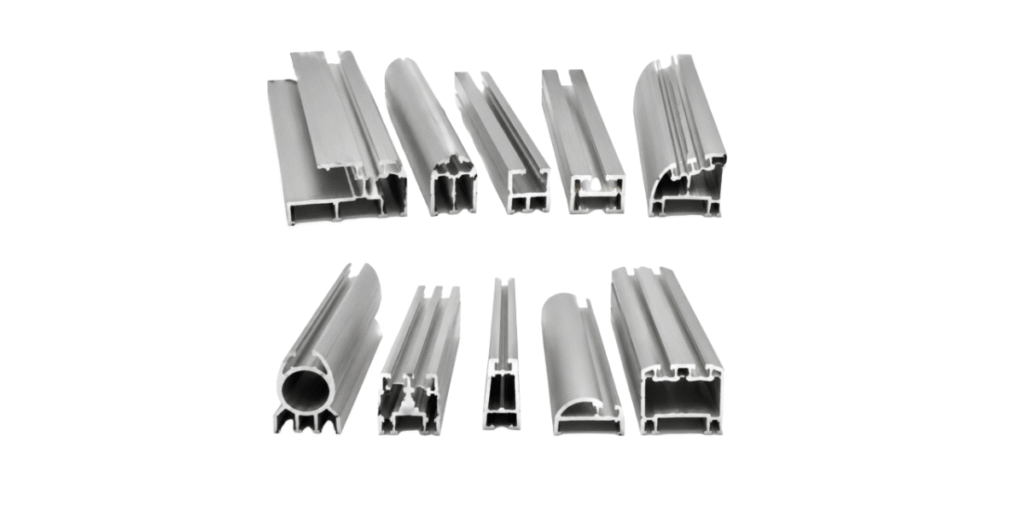
Types of Aluminium Textile Machine Profiles
1. T-Slot Aluminium Textile Machine Profiles
T-slot aluminium profiles are among the most versatile profiles used for textile machinery. The grooves allow brackets, fasteners, panels, sensors, and other components to be attached without extensive welding. These profiles are particularly useful when textile equipment requires a modular machine frame. Engineers can assemble, modify, expand, or reposition components relatively easily.
- Textile machine frames
- Safety guards
- Workstations
- Conveyor structures
- Equipment supports
- Automation frames
- Control-panel structures
2. Hollow Aluminium Machine Profiles
Hollow aluminium profiles are designed to provide structural strength while keeping the overall weight of the textile machine relatively low. Their internal cavities reduce unnecessary material while maintaining useful rigidity.
- Large machine frames
- Cross members
- Structural supports
- Fabric handling equipment
- Machine enclosures
- Conveyor frameworks
3. Square Aluminium Profiles
Square aluminium profiles are widely used for machine frameworks because their symmetrical shape makes them suitable for building stable structures.
- Vertical machine supports
- Horizontal frame members
- Equipment stands
- Conveyor frames
- Guarding structures
- Workstation frames
4. Rectangular Aluminium Profiles
Rectangular profiles are useful when a textile machine requires greater structural width or a particular mounting surface. Their geometry allows engineers to select the appropriate profile according to load, span, available space, and machine design.
- Long machine beams
- Textile equipment frames
- Support rails
- Machine covers
- Cross supports
- Material-handling structures
5. C-Type Aluminium Profiles
C-type aluminium profiles feature an open channel that can provide convenient space for mounting or guiding components.
- Guide systems
- Mounting components
- Cable routing
- Sliding arrangements
- Machine supports
- Protective structures
Conclusion
An Aluminium Textile Machine Profile in Europe can provide an effective structural solution for modern textile machinery. Its lightweight construction, strength, corrosion resistance, machinability, and customisation possibilities make aluminium extrusion suitable for machine frames, guards, conveyors, workstations, automation equipment, and support structures. For textile machinery manufacturers and industrial buyers, choosing the right aluminium profile manufacturer is an important step toward achieving reliable and efficient machine construction. We are the best Aluminium Textile Machine Profile Exporter.
The combination of lightweight construction, strength, corrosion resistance, easy fabrication, and modular assembly makes aluminium profiles suitable for textile machine frames, guards, conveyors, workstations, automation systems, and supports. Kesari Aluminium Company can be a reliable partner for businesses looking for quality aluminium profile solutions for textile machinery and industrial applications. By selecting the right alloy, profile size, slot design, finish, and customisation, manufacturers can develop efficient and durable machine structures for modern production environments.